
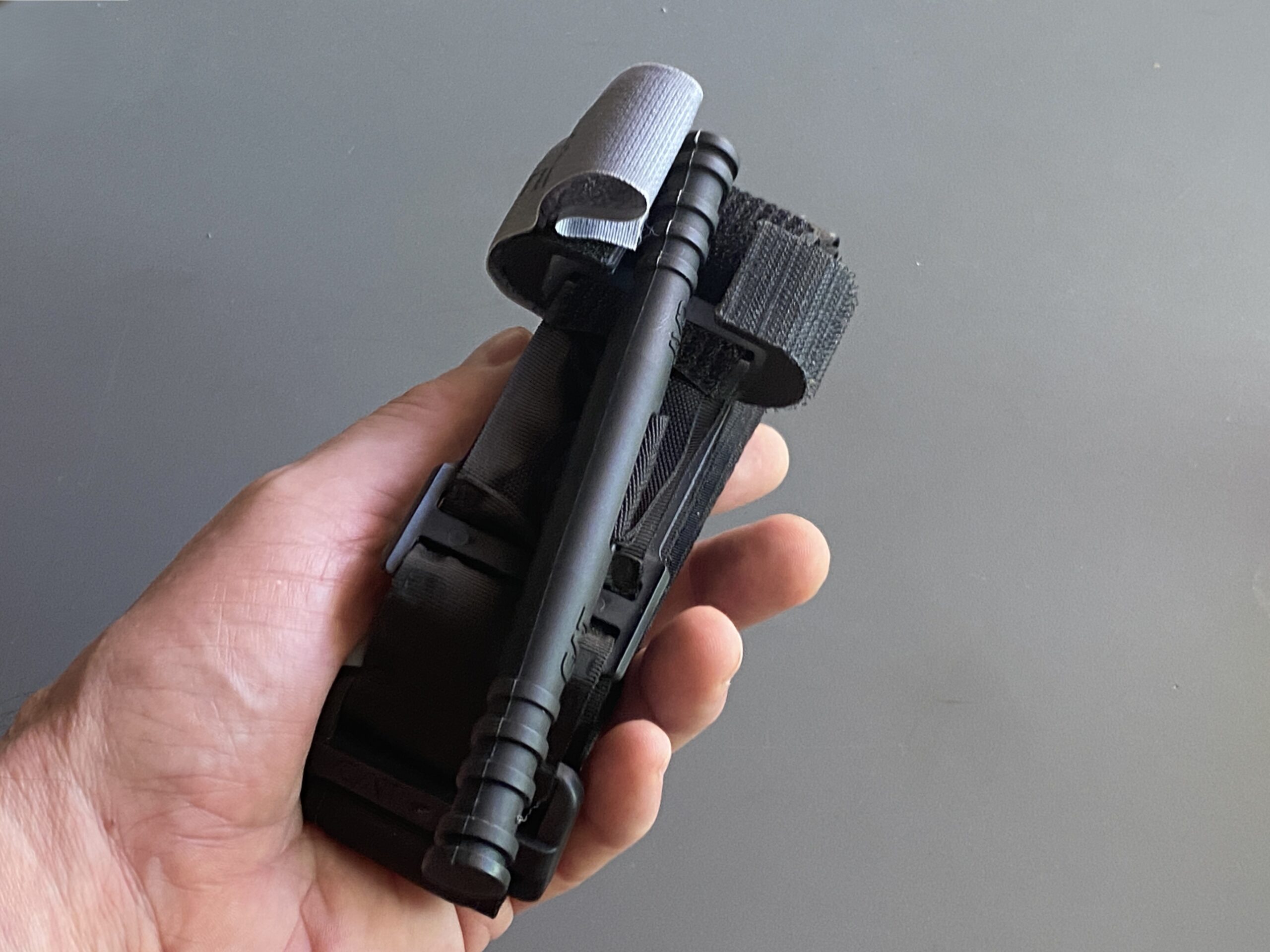
In traumatic emergencies such as car accidents, gunshot or stab wounds, industrial accidents, or even household injuries involving broken glass, uncontrolled bleeding can lead to rapid blood loss, shock, and death. In situations involving severe, life-threatening limb bleeding where direct pressure is ineffective, a tourniquet can be a critical lifesaving tool. Having one readily available can mean the difference between life and death..
There are many high-quality tourniquets available today, and I am often asked which one I carry and why. As someone who values practical emergency preparedness, I have chosen the Combat Application Tourniquet® (C-A-T®) Gen 7 as my primary tourniquet. That decision was based not on brand recognition or popularity alone, but on a careful review of the scientific literature, military experience, and recommendations from leading trauma care organizations. When evaluating lifesaving equipment, I place particular importance on demonstrated effectiveness, ease of use under stress, reliability in real-world conditions, and performance among both trained and untrained users. Based on these criteria, the C-A- Gen 7 consistently stands out as one of the most thoroughly studied, widely adopted, and operationally proven tourniquets available.
It is important to note that there are several excellent tourniquets on the market today, and users are unlikely to make a poor choice by selecting any genuine limb tourniquet currently recommended by the Committee on Tactical Combat Casualty Care (CoTCCC). Devices such as the SOF® Tourniquet and the C-A-T have accumulated substantial evidence supporting their effectiveness in preventing death from extremity hemorrhage. I have carried and extensively trained with both. Each has its own strengths. My preference for the C-A-T Gen 7 should therefore not be interpreted as criticism of other approved tourniquets. Rather, the C-A-T’s extensive body of supporting research, long operational history, ease of application, and status as the standard-issue tourniquet of the U.S. Army make it the option I have chosen to carry as my primary hemorrhage-control device.
Uncontrolled extremity hemorrhage remains one of the leading causes of preventable death following traumatic injury. Since the early years of the Global War on Terror, advances in hemorrhage control have dramatically improved survival rates among both military personnel and civilians. Among the various tourniquet designs available today, the C-A-T Gen 7 has become one of the most extensively studied, widely deployed, and evidence-supported tourniquets in modern trauma care. Its combination of proven effectiveness, ease of use, extensive military validation, and strong performance in civilian settings has led many trauma professionals to regard it as the current benchmark for prehospital extremity hemorrhage control (Bulger et al., 2014; Kragh et al., 2009).
Extensive Scientific Validation
A distinguishing characteristic of the C-A-T Gen 7 is the breadth of scientific literature supporting its use. Unlike many newer commercial tourniquets, the C-A-T has been evaluated in military operations, civilian trauma systems, simulation studies, laboratory testing, and training environments.
Research by Kragh et al. (2009) demonstrated that timely tourniquet application significantly improved survival among combat casualties suffering major extremity trauma. This landmark study helped establish tourniquets as a cornerstone of modern Tactical Combat Casualty Care (TCCC) and contributed to widespread adoption of devices such as the C-A-T.
Subsequent investigations found that commercially manufactured windlass tourniquets consistently outperform improvised methods, which often fail to generate sufficient pressure to stop arterial blood flow (Wall et al., 2013). Because the C-A-T was among the earliest and most widely fielded modern windlass tourniquets, it subsequently accumulated one of the largest evidence bases of any hemorrhage-control device currently available.
Superior Performance in User Application Studies
Effectiveness in controlled laboratory conditions does not always translate into effectiveness during real emergencies. For this reason, many investigators have examined whether ordinary people can successfully apply tourniquets under stress.
Studies involving laypersons and newly trained responders have found high rates of successful C-A-T application following brief instruction. Goolsby et al. (2018) reported that hemorrhage-control trainees could effectively apply modern commercial tourniquets after standardized training, supporting their inclusion in public bleeding-control initiatives such as Stop the Bleed®.
Other comparative research has demonstrated that C-A-T tourniquets frequently achieve higher rates of successful arterial occlusion and lower application failure rates than improvised alternatives and some competing tourniquet designs. Since hemorrhage control depends on correct application, devices that simplify training and reduce user error offer important practical advantages in both military and civilian settings.
Design Features That Enhance Reliability
The C-A-T Gen 7 incorporates multiple design refinements intended to increase effectiveness and reduce application errors. These include:
A single-routing buckle system that simplifies application
Improved slack removal before windlass tightening
A reinforced windlass rod and stabilization platform
Enhanced securing mechanisms to prevent loosening
A clearly marked write-on area for documenting application time
These features help users apply adequate circumferential pressure rapidly while maintaining device stability during transport and patient movement (North American Rescue, 2024).
The C-A-T’s windlass mechanism provides substantial mechanical advantage, enabling most users to generate sufficient force to occlude arterial blood flow in both upper and lower extremities. Laboratory testing has shown that windlass-based tourniquets generally achieve higher and more reliable occlusion pressures than elastic or improvised devices (Wall et al., 2013).
User-Friendly for Both Trained and Untrained Responders
One of the C-A-T Gen 7’s major strengths is its usability. A device may be mechanically effective, but if users cannot apply it quickly and correctly under stress, its real-world value diminishes.
The C-A-T was specifically designed for both self-application and buddy-aid scenarios. Importantly, it can be applied one-handed to an injured upper extremity, allowing wounded individuals to treat themselves when no assistance is immediately available. This capability has been particularly valuable in military operations, where self-aid is often a critical component of casualty survival.
The Gen 7 design further simplified training by standardizing the application process. As a result, instructors across military, law enforcement, emergency medical services, and civilian training programs can teach a single, repeatable technique that promotes skill retention and confidence.
Validation Through Military and Civilian Deployment
Few medical devices can match the C-A-T’s extensive operational history. The C-A-T has been issued widely throughout the U.S. military and has been used in combat operations for many years. It is also commonly carried by law enforcement officers, emergency medical personnel, firefighters, tactical teams, and civilian first responders.
The widespread adoption of tourniquets during military operations in Iraq and Afghanistan transformed battlefield medicine and contributed significantly to reductions in preventable death from extremity hemorrhage (Kragh et al., 2011). The C-A-T’s role in this transformation helped establish its reputation as a reliable and effective hemorrhage-control tool.
Because the device has been used across a broad range of operational environments, it benefits from a depth of real-world experience that relatively newer tourniquet designs often lack.
Recognition by Tactical Combat Casualty Care
The CoTCCC, whose recommendations guide military hemorrhage-control practices and influence civilian trauma systems, includes the C-A-T among its recommended limb tourniquets. Continued recommendation by TCCC reflects extensive testing and evaluation of device performance, safety, and effectiveness.
Although several modern tourniquets currently meet CoTCCC standards, the C-A-T remains one of the most recognizable and extensively validated devices within those recommendations. Its long-standing presence in military protocols has further strengthened confidence among trauma professionals and educators.
The Importance of Authentic C-A-T Tourniquets
Research has demonstrated that not all C-A-T-style tourniquets perform equally. Mechanical testing of counterfeit and imitation devices has shown significant deficiencies in durability, compression force, and overall reliability when compared with authentic C-A-T tourniquets (Teague et al., 2023).
These findings reinforce recommendations from trauma experts and emergency preparedness organizations that users purchase only genuine C-A-T tourniquets from reputable manufacturers and distributors.
Final Thoughts
While several commercially available tourniquets can effectively control life-threatening extremity hemorrhage, the Combat Application Tourniquet (C-A-T) Gen 7 stands apart because of its unparalleled combination of scientific validation, operational history, reliability, and ease of use. Decades of military experience, extensive peer-reviewed research, successful performance in training and real-world emergencies, and continued endorsement by Tactical Combat Casualty Care authorities have established the C-A-T Gen 7 as one of the most trusted tourniquets in modern trauma medicine.
For these reasons, many trauma surgeons, emergency physicians, military medics, paramedics, law enforcement professionals, and bleeding-control instructors continue to regard the C-A-T Gen 7 as the reference standard for prehospital extremity hemorrhage control.
While no piece of emergency equipment can guarantee a positive outcome, carrying a proven tourniquet and knowing how to use it is far more important than debating minor differences between quality CoTCCC-recommended models.

References
Bulger, E. M., Snyder, D., Schoelles, K., Gotschall, C., Dawson, D., Lang, E., Sanddal, T., Butler, F. K., Fallat, M., Taillac, P., White, L., Salomone, J. P., Seifarth, C., & Roberts, K. (2014). An evidence-based prehospital guideline for external hemorrhage control. Prehospital Emergency Care, 18(2), 163-173. https://doi.org/10.3109/10903127.2014.896962
Committee on Tactical Combat Casualty Care. (n.d.). Recommended devices and adjuncts. Defense Health Agency.
Goolsby, C., Strauss-Riggs, K., Hensley, J., Martin, K., & Klingberg, J. (2018). Tourniquet application success among trainees after hemorrhage control instruction. Military Medicine, 183(Suppl. 2), 521-524. https://doi.org/10.1093/milmed/usy129
Kragh, J. F., Walters, T. J., Baer, D. G., Fox, C. J., Wade, C. E., Salinas, J., & Holcomb, J. B. (2009). Survival with emergency tourniquet use to stop bleeding in major limb trauma. Annals of Surgery, 249(1), 1-7. https://doi.org/10.1097/SLA.
Kragh, J. F., O’Neill, M. L., Walters, T. J., Dubick, M. A., Baer, D. G., Wade, C. E., Blackbourne, L. H., & Holcomb, J. B. (2011). The military emergency tourniquet program’s lessons learned with devices and designs. Military Medicine, 176(10), 1144-1152. https://doi.org/10.7205/MILMED-D-11-00044
North American Rescue. (2024). Combat Application Tourniquet® (C-A-T®) Gen 7 product information. North American Rescue.
Schroll, R., Smith, A., McSwain, N., Myers, J., Rocchi, K., Inaba, K., Bee, T., Coke, J., Duchesne, J., & Friese, R. (2015). A multi-institutional analysis of prehospital tourniquet use. Journal of Trauma and Acute Care Surgery, 79(1), 10-14. https://doi.org/10.1097/TA.0000000000000647
Teague, D. C., Sherrer, J., Widness, J., & Katz, M. (2023). Mechanical performance comparison of genuine and counterfeit commercial tourniquets. Journal of Special Operations Medicine, 23(4), 38-45.
Wall, P. L., Duevel, D. C., Hassan, M. B., Welander, J. D., Sahr, S. M., Buising, C. M., & Holcomb, J. B. (2013). Tourniquets and occlusion: The pressure of design. Military Medicine, 178(5), 578-587. https://doi.org/10.7205/MILMED-D-12-00490
Medical Disclaimer
Medical Disclaimer: This article is intended for educational and informational purposes only and does not constitute medical advice. The views expressed are based on my review of available research, military experience, and professional guidance regarding tourniquet use. While I have chosen to carry the C-A-T Gen 7 as my primary tourniquet, any genuine CoTCCC-recommended tourniquet can be an effective lifesaving tool when properly used. Readers are strongly encouraged to obtain hands-on hemorrhage-control training through qualified programs such as Stop the Bleed® and to seek professional medical care whenever possible.