
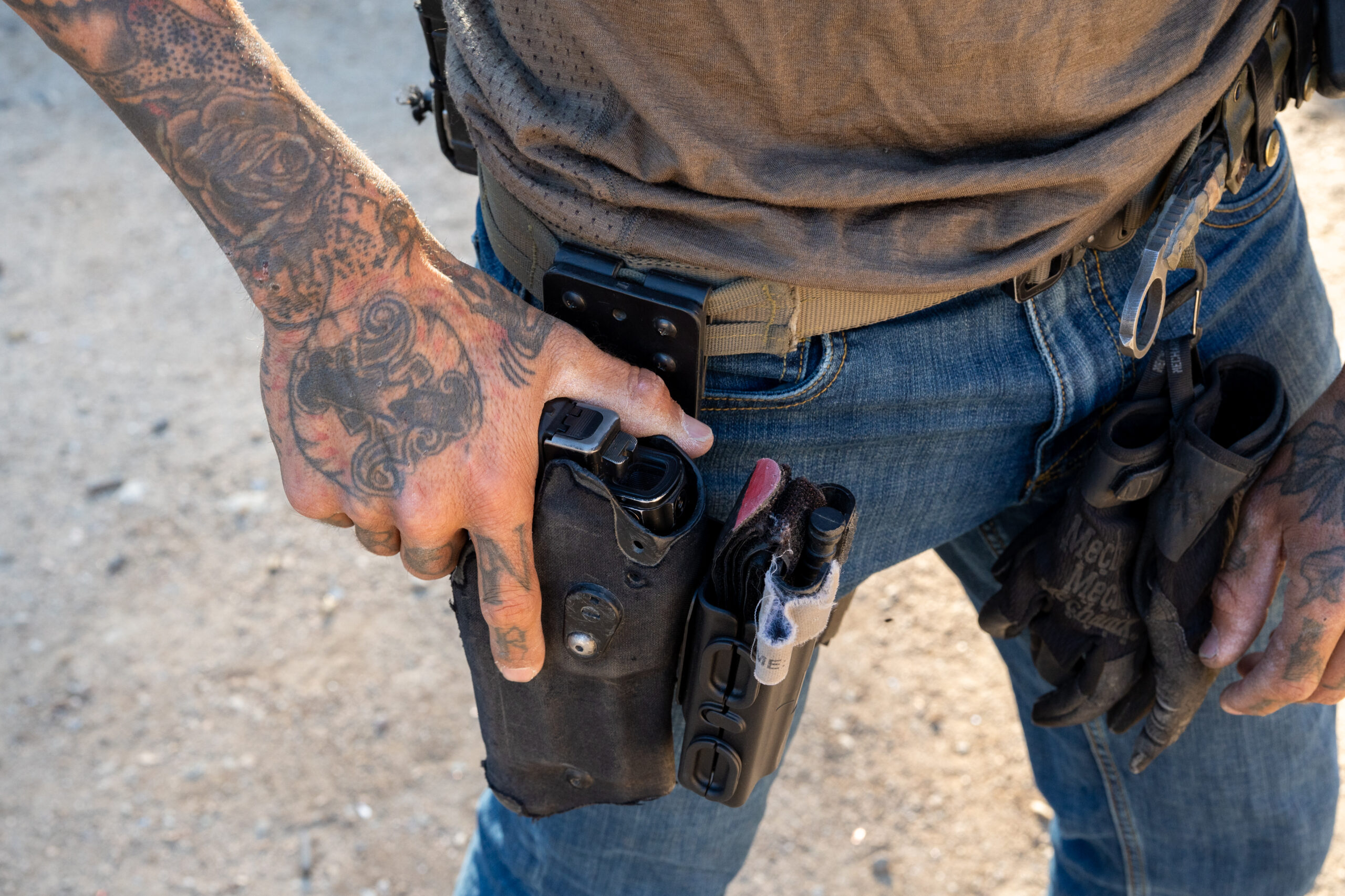
Hemorrhage secondary to traumatic injury is the leading cause of death for Americans between one and 46 years of age. Up to half of all hemorrhage‑related deaths occur before a patient reaches definitive care. ¹ A person who is severely bleeding can die in as little as five minutes.² Hemorrhage from compressible injuries is the most preventable cause of traumatic death. The only thing more tragic than a life lost is a life lost that could have been saved.
According to published research, EMS units average approximately seven minutes from the time of a 911 call to arrival on scene. In rural areas, the median response time exceeds 14 minutes, and nearly 10% of calls wait close to 30 minutes for help to arrive.³ You do the math.
Tourniquets have become the standard of care because they are easy to use, can be applied quickly, and are highly effective at completely stopping extremity bleeding. Current protocols consider the tourniquet an initial lifesaving intervention for massive extremity hemorrhage. If you carry only one medical device, it should be a tourniquet—along with nitrile gloves to protect yourself from blood‑borne pathogens. Carrying a tourniquet, and knowing how to use it properly, can save a life—possibly your own. Statistically, you are far more likely to need your tourniquet than your firearm. You are your own first responder.
However, not all tourniquets are created equal. Some are ineffective, unsafe, or even dangerous. That is why it is essential to choose a tourniquet that meets the standards of the Committee on Tactical Combat Casualty Care (CoTCCC). The CoTCCC evaluates and recommends best practices for treating combat‑related injuries and maintains a list of tourniquets proven to be reliable, durable, and easy to use. Choosing a CoTCCC‑recommended tourniquet ensures you have a high‑quality device capable of saving lives in an emergency.
How you carry a tourniquet also matters. You must be able to access it quickly when seconds count. Your tourniquet is useless if you can’t reach it. While storing a tourniquet in a med kit, bag, or pack is simple, carrying one on your person requires more thought. Dropping a tourniquet loosely into a pocket limits accessibility and makes it difficult for others to locate. Rubber‑banding it to your gear offers little protection and increases the risk of snagging, failure, or loss. A good tourniquet holder prevents these issues and keeps your tourniquet protected, accessible, and ready when needed. But just like tourniquets themselves, not all tourniquet holders are created equal.
Safariland Tourniquet System
Safariland® needs no introduction. The company is a leading manufacturer of safety, protective, and survivability equipment serving law‑enforcement, military, public‑safety, and recreational markets. Founded in 1964 by Neale Perkins in Sierra Madre, California, the company began with custom holster designs inspired by his early experiences on African safaris. Over time, Safariland has expanded into a global provider of protective solutions, including body armor, duty gear, and communications equipment. Its mission, “Together, We Save Lives,” reflects an organizational focus on developing reliable, performance‑driven products that support end‑users in high‑risk environments.
The Safariland Tourniquet (TQ) System is an innovative tourniquet mounting solution designed to provide consistent, accessible placement of a tourniquet within Safariland’s holster ecosystem. The system combines a machined aluminum bracket with a retention‑focused pouch, enabling officers to carry major tourniquet models without affecting holster function, weapon access, or duty‑belt configuration.
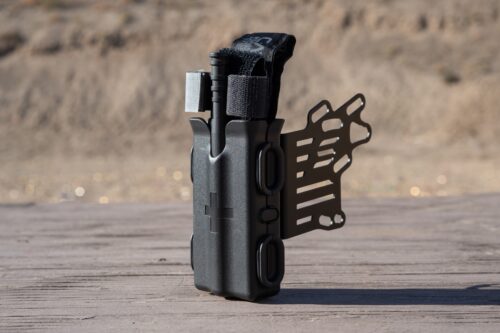
Tourniquet Pouch Design
The pouch is made of a rugged polymer and uses a two‑piece clamshell design secured with rubber O‑rings to provide consistent retention while allowing rapid access. This retention method keeps the tourniquet secure during physical activity yet enables quick removal during medical emergencies. Although compatible with several models, the system was primarily designed around the C‑A‑T tourniquet, which provides the most consistent fit.
The mounting bracket is manufactured from 5052‑H32 aluminum, selected for its corrosion resistance, structural stability, and strength‑to‑weight characteristics. This alloy is commonly used in aerospace, marine, and tactical applications and provides a rigid mounting surface capable of withstanding routine operational stress.
T the bracket supports multiple mounting angles and cants. Both right‑hand and left‑hand configurations are available to match the orientation of Safariland holsters and agency‑specific duty‑belt layouts.
Holster and Accessory Compatibility
The TQ System is engineered to interface with Safariland holsters that use the standard 3‑hole mounting pattern, including the SafariVault™, 7TS™, and 6TS™ series. Its mounting geometry aligns with Safariland’s existing ecosystem, allowing integration without modification to current duty setups.
The bracket also incorporates a tactical hole pattern compatible with Safariland accessories such as the Equipment Locking System (ELS) plate. This supports a range of mounting configurations, including direct attachment to holsters, thigh rigs, and other compatible platforms.
The TQ System is designed to avoid interference with the draw or reholstering process on SafariVault, 7TS, and 6TS holsters. It can also be mounted directly to Safariland tactical thigh rigs, including single‑ and double‑strap versions. (Note: it is not compatible with Lightweight Plate variants of Safariland thigh rigs.)

Belt‑Mounted and MOLLE Options
The pouch has been designed for maximum versatility. The pouch can be hard‑mounted to the Safariland HOLLE™ Duty Belt or attached using the Safariland 744BL belt clip, accommodating belt widths from 1.5 in. (38 mm) to 2.25 in. (58 mm). This enables tourniquet carriage independent of the holster for duty, training, or plain‑clothes use.
Compatibility with the Safariland MSA adapter also allows mounting to MOLLE vests, outer carriers, and MOLLE‑equipped belts, supporting integration across patrol, tactical, and military loadouts.

Operational Considerations
The TQ System provides a consistent, accessible location for a tourniquet—an increasingly standard component of law‑enforcement medical equipment. Key operational advantages include:
Rapid access under high‑stress conditions
Secure retention during movement or physical engagement
Modular placement to support individual or agency configurations
Compatibility with existing Safariland equipment, reducing the need for additional purchases
Final Thoughts
Mounting a tourniquet directly to a holster setup is a practical modification that can meaningfully improve response time in a critical incident. Keeping lifesaving medical equipment in a consistent, easily accessible location ensures it’s available when seconds truly matter.
The Safariland TQ System is an excellent solution for this type of setup. It offers a purpose‑built, highly secure way to mount a tourniquet directly to a holster platform without relying on improvised hardware or ad‑hoc modifications. Its modular design and compatibility with Safariland duty holsters make it a versatile option for users who want consistent placement, reliable retention, and a streamlined profile that integrates seamlessly into an existing loadout.
The Safariland TQ System pouch is offered i in Black or Flat Dark Earth. Depending on the configuration in has a MSRP of $88.00 to $122.00. It is made in the USA.
Endnotes
Donley ER, Munakomi S, Loyd JW. Hemorrhage control. In: StatPearls [Internet]. Treasure Island (FL): StatPearls Publishing; 2022 Jan–. Updated 2022 Nov 16. PMID: 30571014.
American Red Cross. (n.d.). First Aid for Severe Trauma (FAST) training. American Red Cross.
Mell HK, Mumma SN, Hiestand B, Carr BG, Holland T, Stopyra J. Emergency medical services response times in rural, suburban, and urban areas. JAMA Surgery. 2017;152(10):983–984. doi:10.1001/jamasurg.2017.2230.

Material Disclosure
I received this product as a courtesy from the manufacturer so I could test it and give my honest feedback. I am not bound by any written, verbal or implied contract to give this product a good review. All opinions are my own and are based off my personal experience with the product.
*The views and opinions expressed on this website are solely those of the original authors and contributors. These views and opinions do not necessarily represent those of Spotter Up Magazine, the administrative staff, and/or any/all contributors to this site.
Photos by Murray Road Agency