
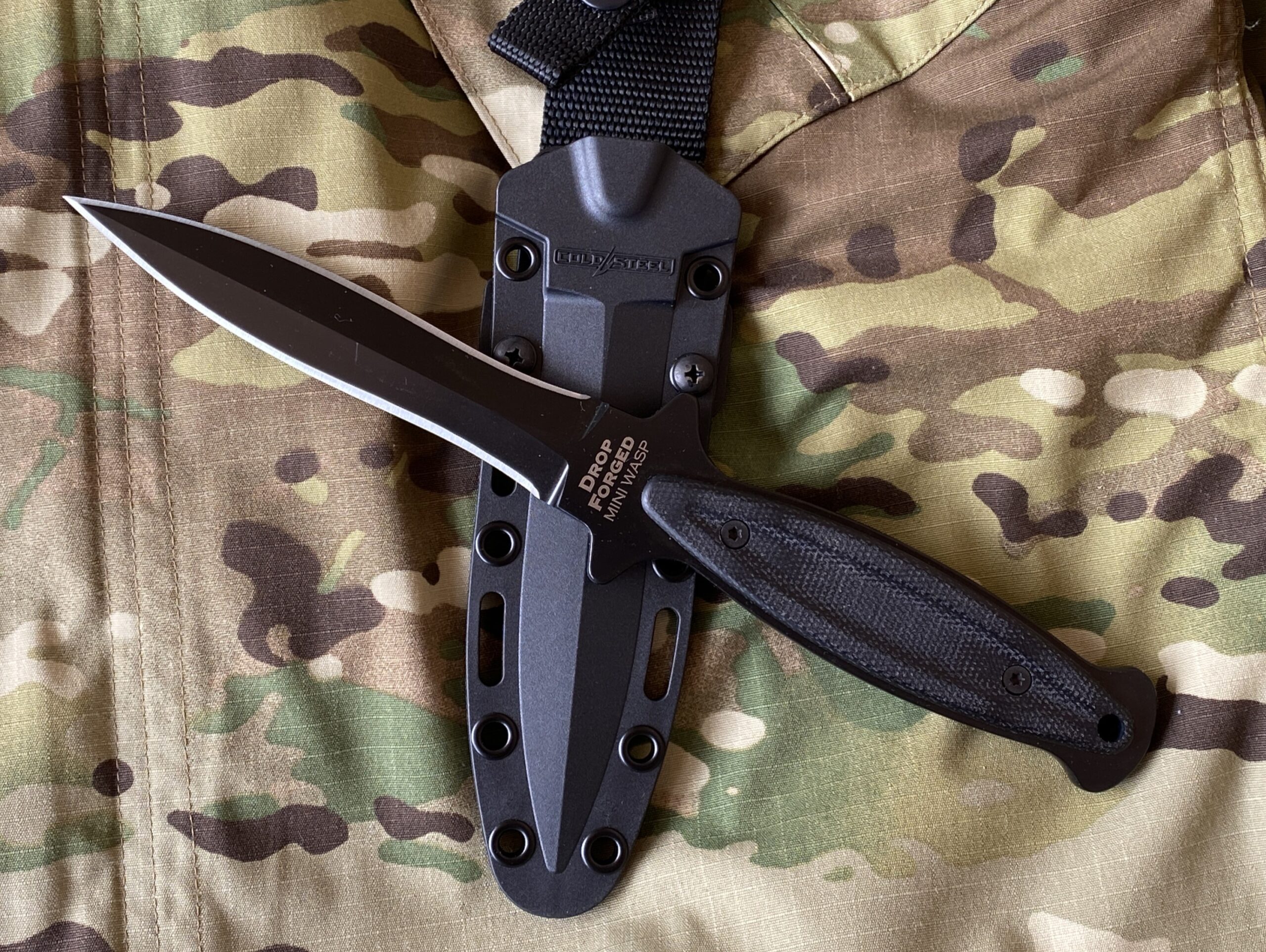
Cold Steel® has introduced a compact, easily concealable evolution of its Drop Forged Wasp Dagger. Like its full‑sized predecessor, the new Drop Forged Mini Wasp Stinger blends historical combat‑knife heritage with modern metallurgy, honoring one of the most iconic fighting‑knife profiles in military history.
Origins of the Modern Fighting Dagger
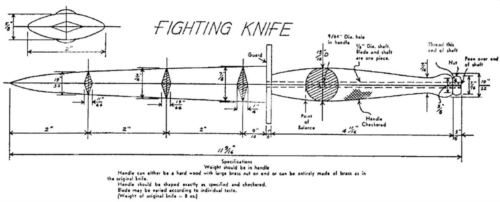
Daggers have served warriors for thousands of years, but few designs are as influential as the Fairbairn‑Sykes (F‑S) Fighting Knife, often called the British Commando Knife. Contrary to its name, the F‑S knife vwas not created for prolonged knife‑on‑knife combat. Instead, it was engineered for silent killing, a critical skill taught to Allied special operations forces during World War II.
The F‑S knife was developed by William Ewart Fairbairn and Eric Anthony Sykes, whose experience in the Shanghai Municipal Police during a notoriously violent era shaped their understanding of close‑quarters lethality. Fairbairn later trained Allied commandos in what he called “Gutter Fighting,” a brutally pragmatic system focused solely on disabling or killing the enemy quickly and decisively.
In his 1942 manual Get Tough!, Fairbairn emphasized two essential qualities in a fighting knife: balance and keenness. A blade must be sharp, fast in the hand, and capable of cleanly severing arteries to ensure rapid incapacitation. These principles continue to influence modern combat knife design—including the Mini Wasp Stinger.
The Drop Forged Mini Wasp Stinger
Although inspired by the F‑S Fighting Knife, the Cold Steel Drop Forged Mini Wasp Stinger is not a reproduction. It is a thoroughly modernized interpretation that uses stronger materials, improved ergonomics, and a more robust construction to meet contemporary tactical needs.
Fairbairn’s earlier Shanghai Dagger also plays an important role in the Mini Wasp Stinger’s lineage. Before the development of the F‑S Fighting Knife, Fairbairn carried and refined a compact double‑edged dagger while serving in the Shanghai Municipal Police—an environment notorious for violent street encounters.
The Shanghai Dagger was shorter, faster, and optimized for close‑quarters lethality, embodying the principles of balance, penetration, and rapid deployment that Fairbairn later formalized in his combatives instruction. The Mini Wasp Stinger echoes this heritage through its compact dimensions and thrust‑oriented geometry, capturing the spirit of Fairbairn’s early design while elevating it with modern materials and engineering.
Monolithic Drop-Forged Design
Drop forging gives the Mini Wasp Stinger its defining structural strength. The knife is formed from a single piece of AISI 52100 high‑carbon alloy steel, compressed between precision‑machined dies while the metal is heated and highly malleable. This process aligns and compacts the steel’s grain structure, producing a blade that is exceptionally dense, tough, and resistant to deformation. Cold Steel then heat‑treats the steel to 57–59 HRC, striking a balance between edge retention, durability, and field‑serviceability.
AISI 52100 is a bearing‑grade steel known for its fine grain and outstanding mechanical performance. Commonly used in aircraft bearings, it offers excellent wear resistance and the ability to take a razor‑sharp edge. Its toughness makes it well‑suited for a compact defensive knife like the Mini Wasp, and its predictable sharpening response means it can be easily honed back to peak sharpness even with basic field tools.
Like all high‑carbon steels, 52100 is not inherently corrosion‑resistant. Its high carbon content increases reactivity to moisture, sweat, and environmental exposure, making it prone to oxidation if left unprotected. To mitigate this, Cold Steel applies a black Teflon® fluoropolymer thermoplastic powder coating that shields the blade from rust and abrasion. The coating also adds lubricity, allowing smoother penetration and reducing friction during use.
The Mini Wasp Stinger’s monolithic full‑tang design further enhances its durability. Because the blade, guard, tang, and pommel are all forged as one continuous piece of steel, there are no joints, welds, or mechanical connections that could fail under stress. Only the black Micarta handle scales are added for grip, and these can be removed for cleaning or replacement. The result is a compact, purpose‑built tool whose strength comes directly from its forged, seamless construction.
Blade Geometry
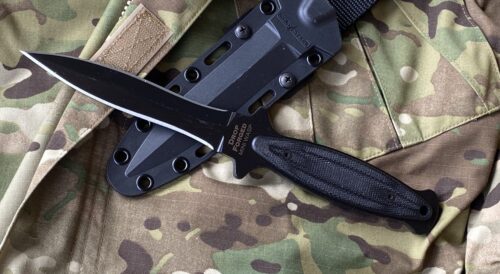
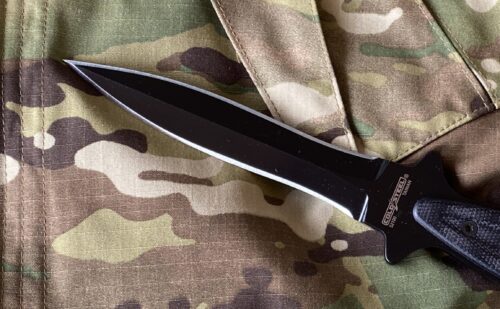
The saber-ground dagger‑style wasp-waist blade measures 4 inches with a 6 mm (0.28 inch) spine thickness. Unlike many traditional double‑edged daggers criticized for brittleness, the Mini Wasp Stinger’s thickness and forging process ensure strength without compromising thrusting efficiency.
The spear point profile focuses all thrusting force along the centerline, enabling deep penetration through heavy clothing—an attribute Fairbairn himself considered essential. The flat, symmetrical grind is optimized for penetration.
The wasp‑waist blade profile also brings functional advantages that complement the Mini Wasp Stinger’s combat‑driven design. By narrowing through the midsection and widening toward the tip, this geometry reduces drag during penetration while subtly shifting mass forward, improving cutting momentum and adding authority to slashing strikes.
The recurve further enhances slashing performance by concentrating force into a smaller initial contact area and creating a natural slicing angle as the cut progresses. It draws material into the inward curve and then drives it along the outward belly, increasing cutting efficiency with less effort.
This combination of agility and striking power is one reason the wasp‑waisted form appears in several iconic fighting knives—most notably the original Gerber Mark II, designed in 1966 by retired Army Captain Clarence A. “Bud” Holzmann. Like the Mark II, the Mini Wasp Stinger benefits from this distinctive shape, offering a fast, responsive feel in the hand while delivering confident thrusting and cutting performance. The trade‑off is that recurved edges are more challenging to sharpen.
Handle Ergonomics
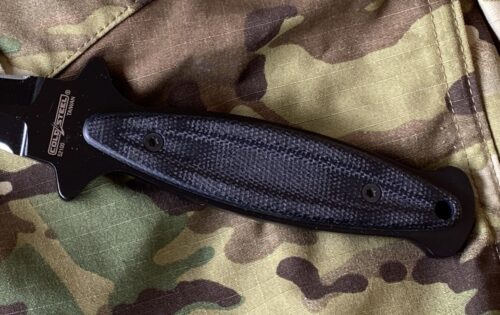
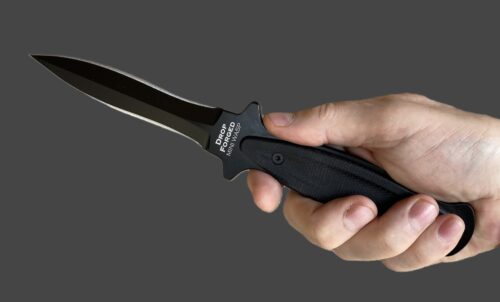
The handle features a Coke®‑bottle contour, reminiscent of the original F‑S knife, but with an improved handle profile that eliminates the indexing issues associated with the round F‑S handle. All edges of the scales are radiused for comfort.
The handle profile coupled with the Micarta scales ensures a secure grip in wet, gloved, or high‑stress conditions. Micarta’s surface actually becomes more tactile when wet, as moisture raises the underlying fabric texture and increases grip. The scales are attached with Torx® screws. The handle is equipped with a lanyard hole.
The double guard is redesigned for practicality. Its forward‑curving shape better supports the “fencing grip” favored by Fairbairn, prevents thumb jamming, and reduces snagging during concealed carry.
Weight & Balance
At just 7.6 ounces and 10.25 inches overall, the Mini Wasp Stinger delivers an ideal blend of compact size and fighting capability. Its weight distribution mirrors that of the classic Fairbairn‑Sykes, with the balance point set just behind the guard. This placement gives the knife a naturally lively, responsive feel, allowing it to track quickly through transitions and recover effortlessly after each movement. The result is a blade that feels fast, agile, and instinctive in the hand—exactly what you want from a purpose‑built fighting dagger
Sheath
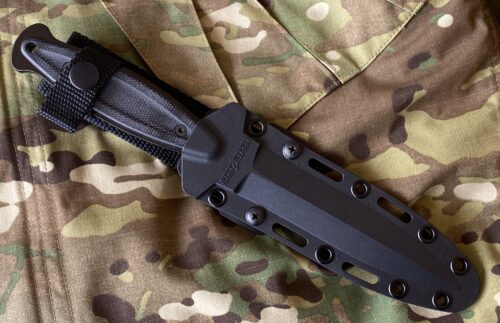
The Secure‑Ex® sheath supplied with the Mini Wasp Stinger is engineered for dependable retention and adaptable carry. Made from rugged thermoplastic, it uses a friction‑fit, self‑locking design that secures the knife with a firm, audible click while still allowing a smooth, controlled draw. There is no rattle.
Multiple tie‑down points provide flexible mounting options, and the ballistic nylon belt loop—equipped with a snap closure—adds an extra layer of security. The belt loop is removable and can be replaced with a Cold Steel Secure-Ex C-Clip or aftermarket clip if a different carry style is preferred. Fully ambidextrous and equipped with a drainage hole for wet environments, the sheath is built to perform reliably in any conditions.
Tactical Purpose with Survival Capability
While the Mini Wasp Stinger is fundamentally a combat‑oriented knife, its rugged monolithic construction gives it more utility than many traditional fighting daggers. It can perform emergency survival tasks in a pinch, though its steep edge geometry prioritizes stabbing power over slicing efficiency. It is not intended for general camp chores or food prep.
Specifications
Specification | Details |
|---|---|
Weight | 7.6 oz |
Blade Thickness | 6 mm |
Blade Length | 4 in |
Steel | Drop‑Forged 52100 High Carbon |
Handle | 4.25 in Micarta |
Overall Length | 10.25 in |
Blade Shape | Double-Edged Spear Point |
Knife Type | Fixed Blade |
Sheath | Secure‑Ex® |
MSRP | $119.99 |
Origin | Taiwan |
Warranty | Cold Steel Limited Lifetime Warranty |
Final Thoughts
The Drop Forged Mini Wasp Stinger stands out as a formidable modern fighting knife. Its monolithic 52100 steel construction, refined ergonomics, and combat‑focused blade geometry place it in a class of its own. Compact, strong, and purpose‑built, it embodies the spirit of the Fairbairn‑Sykes lineage while delivering the performance expected from contemporary tactical tools.
If Fairbairn were alive today, there’s little doubt he would approve of this evolution of his legendary design.
Material Disclosure
I received this product as a courtesy from the manufacturer so I could test it and give my honest feedback. I am not bound by any written, verbal or implied contract to give this product a good review. All opinions are my own and are based off my personal experience with the product.
*The views and opinions expressed on this website are solely those of the original authors and contributors. These views and opinions do not necessarily represent those of Spotter Up Magazine, the administrative staff, and/or any/all contributors to this site.