
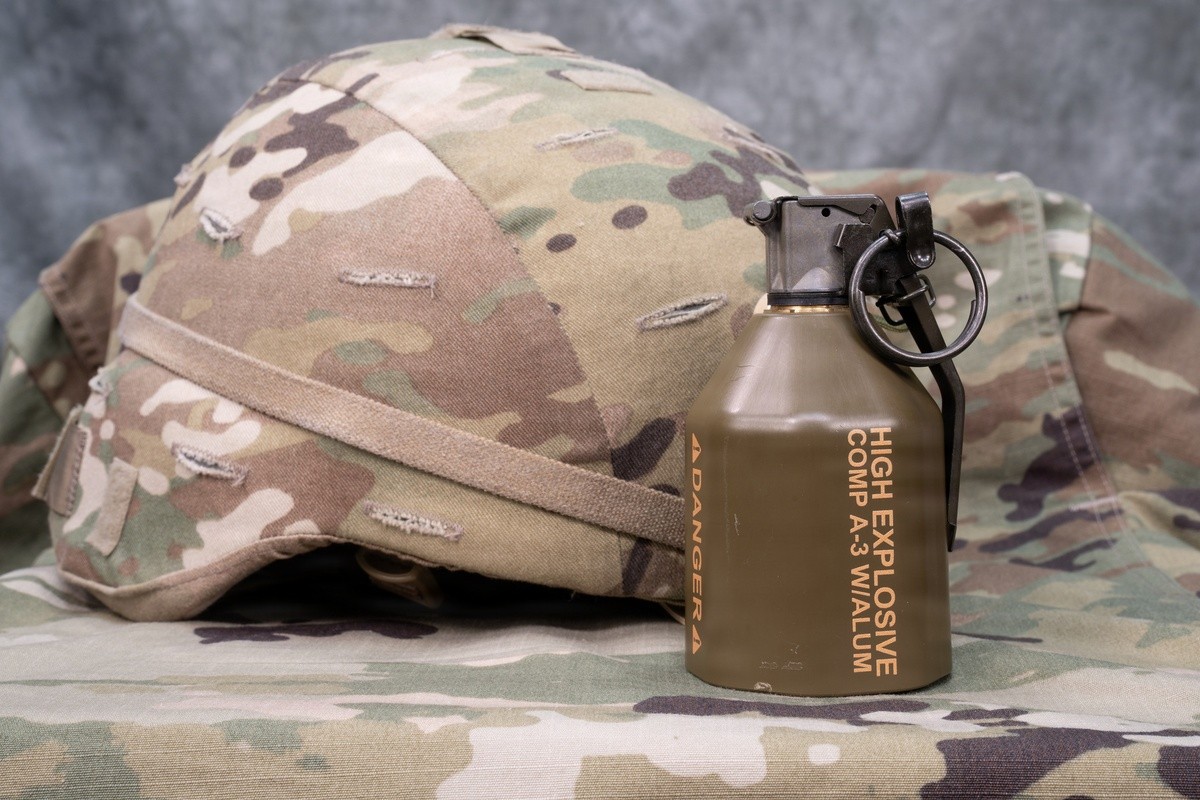
The U.S. Army has approved the M111 Offensive Hand Grenade (OHG) for Full Material Release, marking the first time since the Vietnam era that a new lethal hand grenade has completed the full acquisition and safety certification process. The milestone clears the way for Army‑wide fielding and signals a major modernization step for close‑combat forces.
Developed by the Capabilities Program Executive Ammunition and Energetics (CPE A&E) in partnership with the DEVCOM Armaments Center, the M111 replaces the long‑serving Mk3A2, which has been restricted for years due to its asbestos‑containing body. The M111’s plastic body is fully consumed during detonation, eliminating asbestos hazards and simplifying storage, transport, and training.
Purpose‑Built for Urban Combat and CQB
The M111 is designed around a simple premise: fragmentation is not always the safest or most effective way to clear confined spaces. Instead of relying on fragments, the M111 delivers lethality through blast overpressure (BOP)—a shockwave effect that is far less affected by walls, corners, and obstacles.
This capability directly addresses lessons learned from Iraq and Afghanistan, where Soldiers often found the M67 fragmentation grenade ill‑suited for dense urban terrain. Fragment ricochet, unpredictable deflection, and the risk of injuring friendly forces behind walls or in adjacent rooms limited its utility.
Col. Vince Morris, Project Manager for Close Combat Systems, summarized the operational gap: the M67 wasn’t always the right tool for door‑to‑door fighting; the risk of fratricide was too high. The M111 fills that gap by providing a controlled, non‑fragmenting blast ideal for room clearing, subterranean operations, and other close‑quarters engagements.
In open terrain, Soldiers will continue to rely on the M67 for its fragmenting effects. In enclosed spaces, the M111 becomes the preferred option.
Technical, Logistical & Operational Improvements
The M111 Offensive Hand Grenade introduces several technical, logistical, and operational improvements that benefit Soldiers across all warfighting functions—not just those in the ammunition or ordnance fields.
- Body Material: The grenade uses a plastic composite body that is fully consumed during detonation. This eliminates hazardous residue, removes asbestos concerns associated with the Mk3A2, and simplifies handling, storage, and disposal for all units.
- Fuze Compatibility: The M111 uses the same fuze family as the M67 fragmentation grenade and the M69 training grenade. This commonality reduces supply-chain complexity, eases maintenance requirements, and ensures Soldiers encounter consistent fuze behavior across grenade types.
- Standardized Arming Procedure: The M111 and its training variant, the M112, use the same five‑step arming sequence as the M67/M69 family. This standardization reduces training variance, minimizes user error under stress, and allows Soldiers to “train as they fight” without learning multiple procedures.
- Training Variant (M112): The M112 replicates the handling, weight, and arming characteristics of the M111, enabling realistic training without introducing new steps or equipment. This benefits all Soldiers who train with grenades, not just ordnance personnel.
- Government‑Owned Technical Data Package: The Army retains full intellectual property rights for the M111 and M112. This allows competitive production across multiple vendors, strengthens the industrial base, and reduces long‑term procurement costs—an advantage that ultimately benefits every unit that relies on consistent ammunition availability.
For units responsible for ammunition storage, issue, and accountability, the elimination of asbestos and the standardization of fuzes reduce sustainment burdens and streamline inventory management. For operational units, these improvements translate directly into safer handling, simpler training, and more reliable employment in the field.

Why This Matters for NCOs
For NCOs—particularly infantry squad leaders, engineers, MPs, and SOF team leaders—the M111 introduces new tactical decision‑making considerations:
1. Grenade Employment Becomes Environment‑Driven
NCOs will now teach Soldiers to select grenades based on terrain:
- Open terrain: M67 for fragmentation.
- Enclosed/restricted terrain: M111 for blast overpressure.
This reinforces the NCO’s role in developing Soldiers’ judgment under stress.
2. Training Standardization Reduces Cognitive Load
Because the M111/M112 share the same arming sequence as the M67/M69, NCOs can train one consistent manual of arms across all grenade types. This reduces confusion during high‑stress operations and improves safety.
3. Safer Options for Room‑Clearing
The M111 gives small‑unit leaders a tool that reduces fratricide risk during CQB. This is especially relevant for:
- Urban breaching teams
- Tunnel and subterranean operations
- Mounted/dismounted combined arms teams operating in dense terrain
4. Reinforces Modernization Mindset
The M111 is a tangible example of the Army’s modernization priorities reaching the squad level. NCOs can use this as a professional‑development touchpoint to discuss:
- Lethality modernization
- Acquisition reform
- Industrial base resilience
- Lessons learned from recent conflicts

Acquisition Reform and Cost Efficiency
The M111 program also reflects broader Army efforts to reduce cost while increasing capability. Shared fuzes, standardized arming procedures, and government‑owned IP allow the Army to leverage economies of scale and maintain competitive production lines.
Col. Morris noted that this approach saves taxpayer money without reducing battlefield effectiveness—an important message for leaders responsible for stewardship of resources.
A Modern Grenade for the Modern Battlefield
With Full Material Release approved, the M111 Offensive Hand Grenade is cleared for Army‑wide fielding. It brings Soldiers a safer, more versatile, and more tactically appropriate option for close‑quarters combat—one shaped directly by the operational lessons of the last two decades.
For NCOs, ordnance specialists, and close‑combat formations, the M111 represents not just a new piece of equipment, but a shift in how the Army approaches lethality in confined terrain.
Disclaimer
The appearance of U.S. Department of War visual information does not imply or constitute DOW endorsement.