

The decision to equip a handgun with an optic has become a central consideration for modern shooters. Optics have become standard equipment on defensive handguns, duty pistols, and competition firearms, and their widespread adoption has brought renewed attention to the differences between open emitter and closed emitter designs. Each type offers distinct strengths and weaknesses that influence reliability, durability, maintenance, concealability, and performance. It is essential to understand these characteristics in order to choose an optic that aligns with real‑world needs rather than trends or assumptions.
Open Emitter Pistol Optics
An open emitter optic uses an exposed LED that projects the aiming dot onto the front lens. The LED sits in an open pocket behind the window, allowing manufacturers to keep the housing compact and lightweight. This design has long been popular because it minimizes bulk and provides a wide, unobstructed sight picture. Many concealed‑carry pistols and competition guns rely on open emitters for their fast visual presentation and low mounting height.
The open architecture reduces weight and cost and often enables larger windows relative to the optic’s size. Shooters appreciate the broad view this creates, especially when speed and rapid target transitions are priorities. The tradeoff is that the exposed LED is vulnerable to environmental interference, which can affect reliability in rain, sweat, dust, mud, or carbon‑heavy environments.
Open emitters frequently offer multiple reticle options, such as circle‑dot systems, and many include solar backup features. Battery access varies by model: some use bottom‑mounted batteries that require optic removal, while many modern designs use top‑ or side‑mounted batteries that preserve zero.
Footprint compatibility is a major advantage. Open emitters commonly use RMR, RMSc, DeltaPoint Pro, or Holosun K footprints, all widely supported by factory slides and aftermarket holsters.
Closed Emitter Pistol Optics
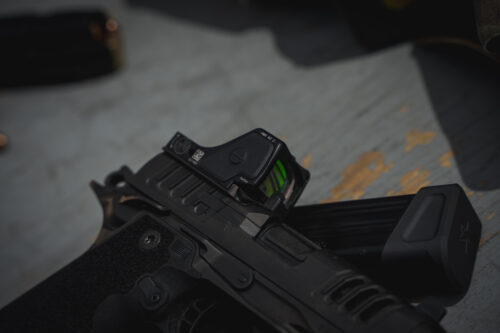
A closed‑emitter optic encloses the LED inside a sealed tube or box. Both the front and rear are protected by glass, creating a sealed environment that prevents moisture, dust, mud, carbon, and debris from reaching the emitter. Although closed emitters were once associated primarily with rifle optics, modern engineering has made them compact enough for pistol use.
The terminology around pistol‑mounted reflex sights can be confusing, because manufacturers sometimes use phrases like “enclosed,” “concealed emitter,” or “protected emitter” to describe designs that are not truly closed‑emitter optics. In industry terms, a closed‑emitter sight is fully sealed front and rear, preventing water, dust, carbon, and debris from reaching the LED or emitter. In contrast, many “enclosed” or “concealed emitter” designs still use an open window and are not sealed against environmental contamination. Understanding this distinction helps shooters evaluate optics more accurately and avoid assuming that every “enclosed” sight is a true closed‑emitter system.
Closed emitters are favored for duty pistols, outdoor environments, and situations where reliability must be maintained regardless of conditions. Their sealed construction ensures the dot remains visible even when the front lens is wet or dirty. Water may distort the lens, but it cannot reach the emitter, so the dot remains stable.
Closed‑emitter pistol optics use enclosed housings that provide increased rigidity, environmental sealing, and better protection for the emitter and lenses. Battery systems vary by model—some use side‑load trays or top‑load compartments, while a few still rely on bottom‑mounted batteries that require optic removal. Their mounting footprints are typically proprietary, such as Aimpoint ACRO, Holosun 509T, or SIG‑LOC PRO, and often require dedicated slide cuts or adapter plates.
Pros and Cons of Open Emitters
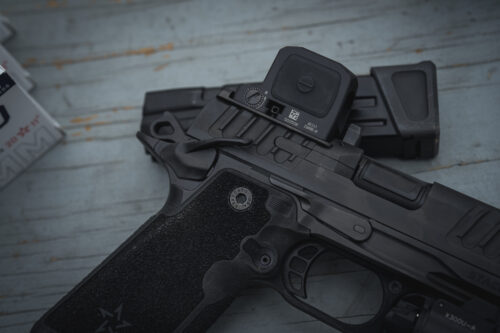
Open‑emitter pistol optics offer several advantages that make them popular for everyday carry and competition. Their light weight and compact dimensions minimize bulk, which is especially beneficial on concealed‑carry pistols and micro‑compacts where slide mass and overall profile matter. Because they sit lower on the slide, they often provide a more natural presentation and easier co‑witnessing with iron sights.
The wide, unobstructed window gives shooters a broad sight picture that feels fast and intuitive, improving target transitions and overall speed in competition. Open emitters also tend to cost less due to simpler construction, and many pistols, holsters, and mounting plates are already designed around common open‑emitter footprints, making integration straightforward. Many models offer features like multi‑reticle systems, large windows, and solar backup, which appeal to shooters who prioritize speed and flexibility.
However, open emitters have inherent vulnerabilities. The exposed LED can be obstructed by rain, sweat, dust, lint, carbon, or debris which can block or distort the dot. Even a small droplet of water reaching the emitter pocket can cause the dot to disappear or refract unpredictably. The open design also leaves critical components more susceptible to damage during slide manipulation or if the pistol is dropped. While many open emitters are durable, the architecture itself exposes the emitter, making regular cleaning necessary to maintain reliability. Shooters who prefer low‑maintenance equipment may find this upkeep undesirable.
Despite these limitations, open emitters remain extremely popular due to their speed, clarity, lower profile, and ease of integration, especially for concealed carry and competition use.

Pros and Cons of Closed Emitters
Closed‑emitter pistol optics offer environmental protection and durability that open‑emitter designs simply cannot match. Their sealed housings prevent moisture, dust, mud, carbon, and debris from reaching the LED, ensuring the dot remains visible even when the front lens is wet or dirty. This reliability is a major advantage for duty use, hunting, and outdoor carry, where conditions are unpredictable and optics must perform regardless of weather or contamination.
Closed emitters are typically built with reinforced housings designed for hard use. They tolerate impacts, slide manipulation, and rough handling more effectively than open designs. Because the emitter is enclosed, the optic continues functioning even if the exterior is scratched, dented, or covered in debris, an important benefit in defensive situations where the gun may be used at awkward angles or in compromised environments.
Their architecture also reduces dot washout when shooting from retention or in extreme backlighting. By limiting stray light entering the optic, closed emitters maintain better dot contrast in challenging lighting conditions.
Window size and sight picture vary significantly across closed‑emitter pistol optics. Some models, like the Aimpoint ACRO P‑2, have compact windows that can feel more tunnel‑like. Others, such as the Holosun EPS/EPS Carry, Holosun 509T, and Steiner MPS, offer larger or less restrictive sight pictures that feel closer to traditional open‑emitter optics. As a result, not all closed emitters feel confining, and many modern designs strike a strong balance between durability and visibility. Several manufacturers, including Holosun, also offer switchable reticles, while others remain dot‑only.
These strengths come with tradeoffs. Closed emitters are generally larger and heavier, which can affect concealability and may require updated holsters or mounting plates due to proprietary footprints. On smaller pistols, the added mass can influence slide behavior. Their sealed construction and rugged design also increase cost, and battery access can be less convenient depending on the model. Users must weigh these factors against the substantial reliability benefits.
Despite these considerations, closed‑emitter optics have become increasingly popular as more models enter the market. Options now range from duty‑grade units like the ACRO P‑2, 509T, and MPS to compact carry‑focused designs such as the Holosun EPS and EPS Carry. This expanding ecosystem gives shooters more choices than ever when selecting a closed‑emitter optic that fits their needs, gun, and intended use.
Battery access varies by model rather than emitter type. Many open emitters now offer top‑load or side‑load batteries that do not disturb zero, though some still require removal to change batteries. Closed emitters vary as well: some use external trays, while others require removal due to bottom‑mounted battery compartments.

Choosing Between Open and Closed Emitters
Consider Your Environment
Environmental conditions are one of the most important factors when choosing between open and closed emitters. Shooters who regularly encounter rain, sweat, dust, or mud benefit from the sealed reliability of a closed emitter. Outdoor workers, hikers, hunters, and law enforcement officers often consider the enclosed design essential. For indoor ranges, competition, or mild climates, an open emitter is usually sufficient and offers a lighter, lower‑profile option. However, even indoor or concealed‑carry shooters may prefer a closed emitter if sweat or debris frequently reaches the optic.
Consider Your Intended Use
It is important to consider your intended use. Duty or defensive use in potentially harsh environments favors closed emitters. Concealed carry can benefit from either type: open emitters offer minimal bulk, while compact closed emitters provide sweat resistance and enhanced reliability. Competition shooters often prefer the speed and openness of a large window. Home‑defense pistols can go either way depending on personal preference, lighting conditions, and environmental factors.
Consider Your Maintenance Habits
Open emitters require more frequent cleaning to keep the LED unobstructed. Shooters who prefer minimal maintenance or want maximum reliability with little effort may find closed emitters more forgiving. Those who carry daily in dusty, humid, or sweaty environments often appreciate the sealed design.
Consider Your Budget, Footprint, and Holster Fit
Open emitters generally cost less and fit more holsters without modification. Closed emitters offer enhanced protection but at a higher price and with more holster considerations.
Footprint compatibility is critical. Closed emitters may require:
Adapter plates
Dedicated slide cuts
Updated holsters
Before choosing an optic, confirm that your slide cut and holster support both the footprint and the physical size of the optic.
Consider Training and Familiarity
Closed‑emitter optics may introduce subtle differences in presentation due to their enclosed window geometry, but most shooters adapt quickly with consistent practice. Regardless of the optic type, reliable dot acquisition comes from repetition, refined mechanics, and a stable draw stroke, not from the specific sight chosen. Building familiarity through regular training is essential.

Final Thoughts
Both open and closed emitter pistol optics are effective tools, but they excel in different contexts. Open emitters offer compact size, wide windows, multi‑reticle options, and lower cost, making them ideal for concealed carry and competition. Closed emitters provide superior environmental protection, durability, and reliability, making them the preferred choice for duty use and harsh conditions.
The best optic is the one that aligns with your environment, your pistol, and your intended use. By understanding the strengths and limitations of each design, including footprint compatibility, battery access, reticle options, and durability differences, you can select the right optic for your needs.