
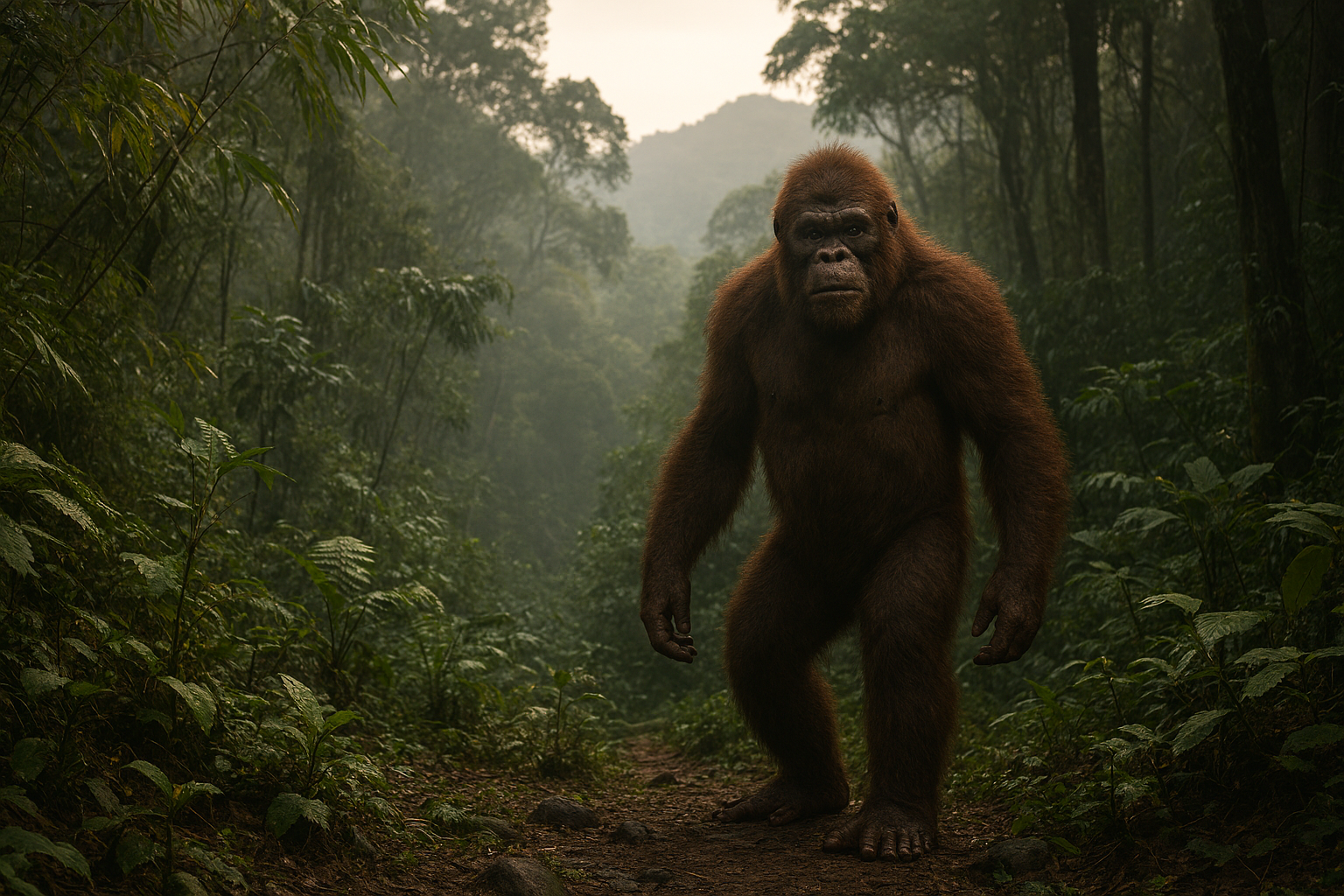
The Vietnam War placed American troops in one of the most unforgiving environments on Earth. The dense jungles, steep mountains, and constant threat of ambush created a setting where danger could come from any direction. Yet among the Viet Cong, booby traps, and relentless heat, many soldiers reported something far stranger — encounters with large, bipedal, ape‑like creatures that seemed to defy explanation. These beings became known as Rock Apes, a name inspired by their habit of throwing stones at soldiers. Reports of these creatures were so numerous and so consistent that they became one of the most enduring legends of the war.
The First Sightings
American troops began reporting encounters early in the conflict. The creatures were described as 5 to 6 feet tall, muscular, and covered in reddish or dark hair. They walked upright, traveled in groups, and made loud, aggressive vocalizations that echoed through the jungle. Soldiers claimed the creatures showed little fear of humans, sometimes approaching patrols closely before being driven off by gunfire.
One of the most active hotspots was the Sơn Trà Peninsula, which troops nicknamed Monkey Mountain because of the sheer number of sightings. According to multiple accounts, entire squads were pelted with rocks at night, and some Marines even reported firing at the creatures when they got too close.
A Mystery Shared by Both Sides of the War
Rock Ape sightings weren’t limited to American forces. Viet Cong and North Vietnamese Army troops also reported encounters with similar creatures. The reports were taken seriously enough that an NVA general allegedly organized an expedition in 1974 to capture or kill one of the beings, a rare example of both sides of the war being united by the same unexplained phenomenon.
This cross‑faction consistency is one of the reasons the legend has endured. Soldiers from opposing armies, with no contact and no shared folklore, described nearly identical creatures.
The Batutut — A Legend Older Than the War
Long before American troops arrived, Vietnamese folklore told of the batutut, also known as the Người rừng (“forest people”). These beings were described as bipedal, hairy, and human‑like, living deep in the remote mountains. The similarities between the batutut and the Rock Apes suggest that soldiers may have been encountering the same phenomenon described in local legends for generations.
This connection between wartime sightings and ancient folklore adds a cultural dimension to the mystery, hinting that the creatures, or at least the stories about them, have deep roots in the region.
A Jungle with No Native Apes
One of the most puzzling aspects of the Rock Ape phenomenon is that Vietnam has no native ape species. The country is home to monkeys, gibbons, and langurs, but none match the size, posture, or behavior described by soldiers. Gibbons, for example, are small and lightweight, and while macaques can be aggressive, they do not walk upright for extended periods or reach human‑like heights.
This biological mismatch has fueled speculation for decades. If the creatures weren’t known primates, then what were they?
Stories From the Field
The Rock Throwing Attacks
Many soldiers described being targeted by unseen creatures that hurled stones with surprising force and accuracy. These attacks often occurred at night, adding to the confusion and fear. The behavior was so distinctive that it became the basis for the creatures’ nickname.
Close Range Sightings
Some Marines reported seeing the creatures at distances of only a few yards. They described them as muscular, human‑shaped, and unafraid. In several cases, soldiers opened fire, though no bodies were ever recovered.
Multi-Witness Events
Entire squads reported encounters, which makes the phenomenon difficult to dismiss as hallucination or misinterpretation. When multiple trained observers describe the same event, the mystery deepens.
Possible Explanations
Misidentified Wildlife
Some researchers argue that soldiers may have misidentified large macaques or gibbons, especially in low‑light conditions. However, this explanation struggles to account for the creatures’ reported size and bipedal movement.
Psychological Stress
The Vietnam War was a high‑stress environment. Fear, exhaustion, and sensory overload can distort perception. Yet this explanation also falls short when considering multi‑witness encounters and consistent descriptions across units.
Folklore Reinforcement
Once the term “Rock Ape” entered military slang, ambiguous encounters may have been interpreted through that lens. Still, this doesn’t explain why Vietnamese soldiers had similar stories long before Americans arrived.
An Unidentified Species
Some cryptozoologists believe the remote Annamite Mountains could conceal unknown primates. The region has produced new species discoveries even in recent decades. While no physical evidence of Rock Apes has been found, the possibility remains intriguing.
Why the Legend Endures
The Rock Ape mystery persists because it sits at the intersection of history, folklore, and the unknown. Soldiers from both sides of the war described similar creatures. Local legends predate the conflict. The environment was harsh, remote, and poorly studied. And the accounts themselves, detailed, emotional, and often corroborated, are hard to ignore.
Even today, veterans continue to share their stories, and researchers continue to debate the phenomenon. Whether the Rock Apes were misidentified animals, stress‑induced visions, or something truly undiscovered, they remain one of the most fascinating and enduring mysteries of the Vietnam War.
