
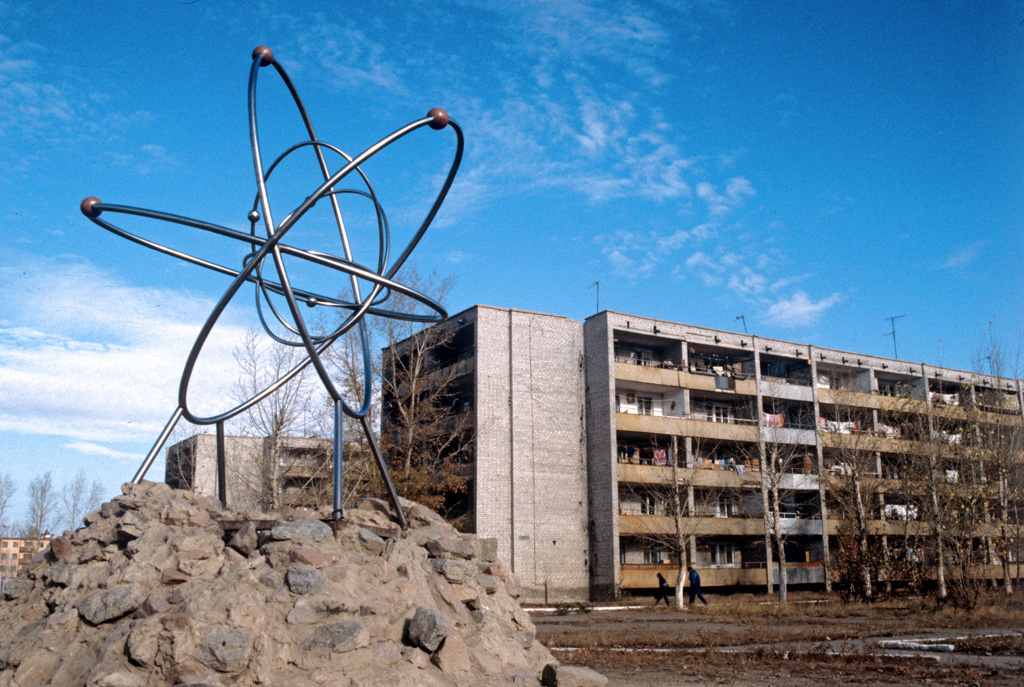
Hidden deep within the vast Kazakh steppe, Semipalatinsk‑21, later known as Kurchatov, was once one of the most secretive locations in the Soviet Union. For decades, it appeared on no maps, guarded by military checkpoints and protected by layers of classified protocols. Between 1949 and 1989, the surrounding nuclear test site, known simply as the Polygon, became the stage for 456 nuclear detonations. Yet the weapons themselves were only part of what the Soviets were testing. The site became a sprawling laboratory for studying the effects of radiation, shockwaves, and nuclear warfare on environments, structures, and human populations.
Origins of a Hidden City
The Soviet Union’s nuclear ambitions accelerated rapidly after World War II. Determined to match the United States, Soviet leadership sought a remote, controllable region where nuclear weapons could be developed and tested in secrecy. In 1947, the Kazakh steppe—sparsely populated and far from foreign borders—was chosen as the ideal location. To support the project, the Soviets constructed a closed administrative city along the Irtysh River. Internally, it was designated Semipalatinsk‑21, a name used only within classified channels. The city housed scientists, engineers, military personnel, and their families, all living under strict confidentiality. It became the operational center of the Soviet nuclear program, with laboratories, research institutes, and military facilities woven into a self-contained urban environment.
The First Soviet Nuclear Explosion
On August 29, 1949, the Soviet Union detonated its first atomic bomb, RDS‑1, at the Polygon. The device, modeled closely on the American “Fat Man,” marked the end of the U.S. nuclear monopoly and signaled the beginning of a new phase in the Cold War. The successful test elevated Semipalatinsk‑21 to a place of immense strategic importance. It also marked the beginning of decades of radiation exposure for the surrounding Kazakh population, who were rarely informed or protected.
A Landscape of Nuclear Experiments
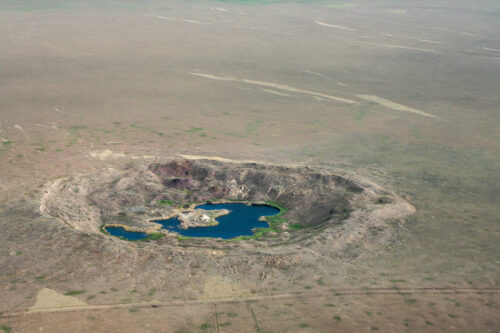
Over the next forty years, the Polygon became one of the most intensively used nuclear test sites in the world. The Soviets conducted atmospheric detonations, underground explosions, and tests of missile warheads and artillery-delivered nuclear devices. They also carried out so‑called “peaceful nuclear explosions” intended for industrial applications, such as creating underground cavities or altering geological formations. Beyond weapons development, the site hosted extensive experiments on buildings, vehicles, and livestock. Entire mock villages were constructed to study how nuclear blasts would affect civilian infrastructure, while animals were placed at varying distances from ground zero to observe radiation effects. Underground tests carved out massive caverns and left behind radioactive tunnels that remain hazardous today.
Human Impact and Long-Term Consequences
While Semipalatinsk‑21’s residents lived in relative comfort, the surrounding Kazakh communities suffered the consequences of repeated nuclear testing. Many villages were located within a short distance of the blast zones, and residents often witnessed mushroom clouds firsthand, unaware of the dangers. Decades of exposure led to widespread health problems, including elevated cancer rates, genetic mutations, birth defects, immune system disorders, and chronic illnesses linked to radiation. Researchers estimate that more than one million people were affected. The full generational impact continues to unfold, with ongoing studies examining long-term genetic and environmental consequences.
Life Inside the Closed City
Semipalatinsk‑21 was a paradoxical place. On one hand, it offered high-quality housing, cultural amenities, and access to goods unavailable elsewhere in the Soviet Union. On the other, it was a tightly controlled environment where secrecy governed daily life. Residents were forbidden from discussing their work, travel was restricted, and the city was surrounded by military checkpoints. Despite the isolation, the community developed a distinct identity: scientific, disciplined, and acutely aware of its role in shaping global geopolitics.
U.S. Intelligence Surveillance
Although Semipalatinsk‑21 was designed to be invisible to the outside world, it quickly became one of the most closely watched locations on the planet. From the moment the Soviet Union detonated its first atomic device in 1949, U.S. intelligence agencies began piecing together the existence and purpose of the secret Kazakh test range. The earliest clues came not from satellites but from the atmosphere itself: American reconnaissance aircraft detected radioactive particles drifting across the Pacific, confirming that the USSR had successfully conducted a nuclear explosion. This discovery triggered a massive intelligence effort to locate and monitor the Soviet testing grounds.
By the 1960s, the advent of high‑resolution spy satellites transformed U.S. surveillance capabilities. Programs such as Corona, Gambit, and Hexagon captured detailed images of the Polygon, revealing craters, test towers, tunnel entrances, and the rapid expansion of Semipalatinsk‑21. Analysts in Washington could track preparations for upcoming tests by observing drilling rigs, instrumentation cables, and the movement of specialized equipment. Seismic monitoring stations around the world further enabled the United States to detect underground detonations, estimate their yield, and assess the sophistication of Soviet nuclear designs.
Despite the secrecy surrounding Semipalatinsk‑21, U.S. intelligence gradually built a remarkably comprehensive picture of the site’s operations. Declassified CIA documents show that analysts tracked every major construction project, from new test tunnels to expanded laboratories.
Analysts understood that the city housed key scientific personnel, that the Polygon served as the USSR’s primary nuclear proving ground, and that the Soviets were experimenting with increasingly advanced warhead technologies. What remained less clear, until the collapse of the Soviet Union, was the human cost. While American scientists recognized that fallout was drifting across borders, the full scale of radiation exposure among Kazakh civilians only became known in the 1990s, when local researchers and newly opened archives revealed the extent of the suffering.
By the end of the Cold War, Semipalatinsk‑21 had become a symbol not only of Soviet nuclear ambition but also of the global intelligence contest that defined the era. For decades, it stood at the center of a silent, high‑stakes surveillance battle—one fought with satellites, seismic sensors, and scientific analysis rather than bombs. Its legacy continues to shape international security and non‑proliferation efforts today
The Decline and Closure of the Polygon
By the late 1980s, the environmental and human toll of nuclear testing became impossible to ignore. A powerful grassroots movement, Nevada–Semipalatinsk, emerged in Kazakhstan, uniting activists, scientists, and citizens in opposition to continued testing. Their efforts coincided with broader political reforms in the Soviet Union. The final nuclear test at the Polygon took place in 1989. In 1991, shortly after Kazakhstan declared independence, the new government officially closed the site—one of its first major acts as a sovereign nation.
Cleanup and International Cooperation
After the collapse of the Soviet Union, Semipalatinsk‑21 and the Polygon became a major security concern. Abandoned facilities, unsecured fissile materials, and radioactive tunnels posed risks of proliferation and environmental contamination.From the early 1990s through the 2000s, Kazakhstan, Russia, and the United States worked together under the Cooperative Threat Reduction program to seal test tunnels, secure leftover nuclear materials, and dismantle hazardous infrastructure at Semipalatinsk. Much of the most sensitive work, particularly efforts to secure fissile material in abandoned tunnels, remained classified for years due to its proliferation risks.
Semipalatinsk-21 Today
Today, the city of Kurchatov is partially open and significantly smaller than during its Cold War peak. Some research institutions continue to operate, focusing on radiation safety, environmental monitoring, and nuclear non-proliferation. The surrounding test range remains largely uninhabited, though controlled scientific expeditions occasionally visit. The site now stands as a symbol of the human cost of nuclear competition, the environmental legacy of the Cold War, and Kazakhstan’s leadership in global non-proliferation efforts. Memorials and museums commemorate the victims, while international researchers study the long-term effects of radiation on ecosystems and human health.
A Legacy That Cannot Be Erased
Semipalatinsk‑21 was once a place that officially did not exist. Yet its impact on global politics, scientific development, and human lives is undeniable. The 456 nuclear tests conducted at the Polygon shaped the Cold War arms race and left a profound imprint on the land and its people. Today, the site serves as a stark reminder of the costs of nuclear ambition.
