
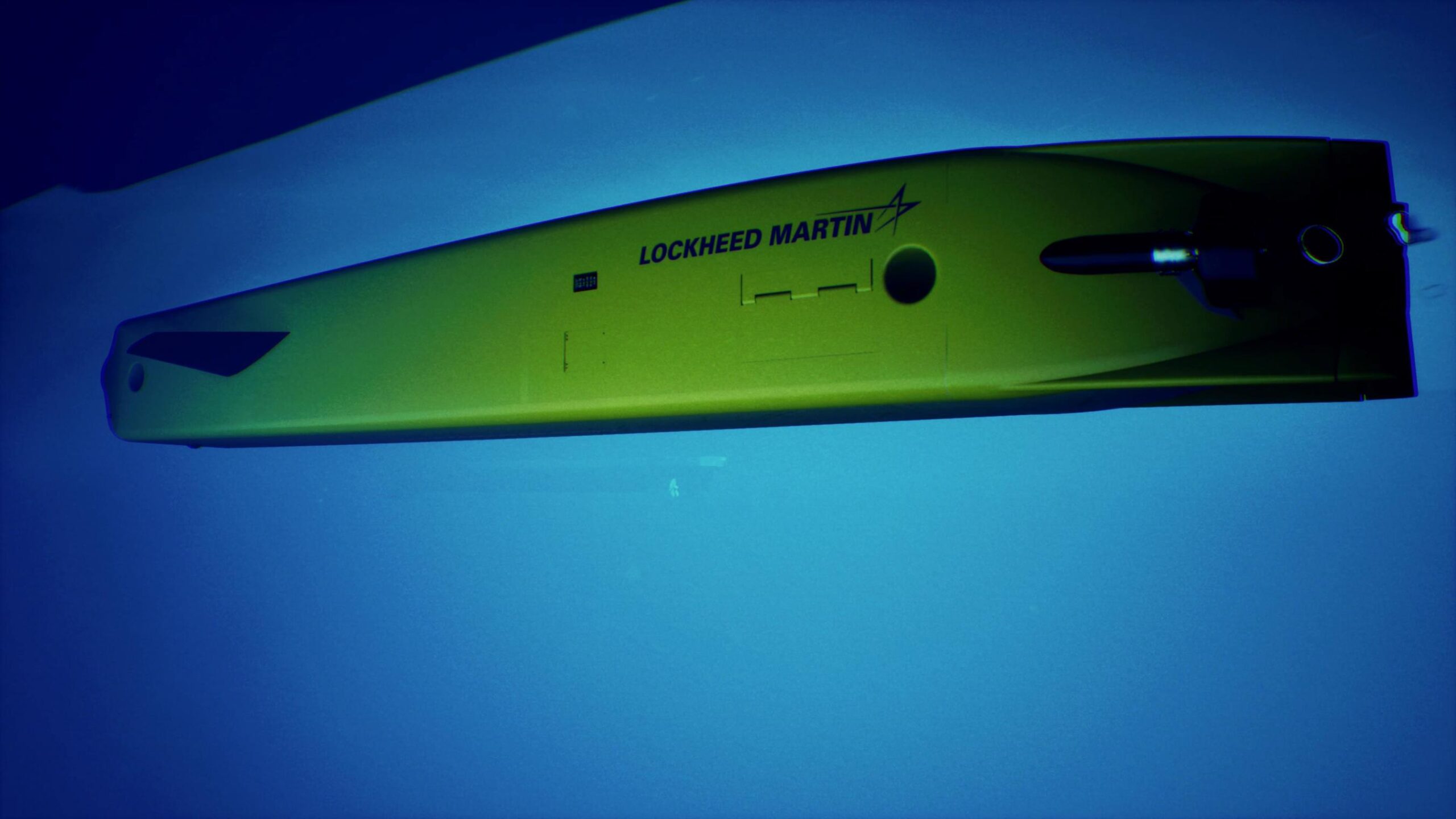
The undersea battlespace is undergoing one of the most significant transformations in decades, driven by the convergence of autonomous systems, distributed operations, and intensifying great‑power competition. As adversaries expand their own undersea capabilities and invest heavily in counter‑access strategies, the U.S. Navy and its allies face mounting pressure to field platforms that can persist, adapt, and operate with minimal risk to personnel. Lockheed Martin’s Lamprey Multi‑Mission Autonomous Undersea Vehicle (MMAUV™) emerges at this inflection point, offering a fundamentally different approach to deployment and mission execution that could reshape how autonomous assets are employed across the maritime domain. Developed through internal investment, the LampreyMMAUV combines biomimetic mobility, modular payload integration, and dual‑mode mission execution to support emerging concepts in distributed maritime operations.
A Host‑Attached Approach to Undersea Mobility
At the core of the LampreyMMAUV’s design is a novel host‑attachment mechanism that allows the vehicle to physically latch onto a surface ship or submarine without requiring structural modifications to the host. This approach eliminates the need for dedicated launch‑and‑recovery systems and reduces the acoustic and electromagnetic exposure associated with independent UUV transit.
While attached, the vehicle uss integrated hydrogenators to recharge its onboard batteries. This enables the system to arrive in theater fully powered, extending operational endurance and reducing reliance on shore‑based or tender‑based logistics. The biomimetic concept—mirroring natural symbiotic behaviors—offers a low‑signature method of deployment that enhances survivability in high‑threat environments.
Modular Architecture for Multi‑Domain Effects
The LampreyMMAUV is built around a payload‑centric open architecture that supports rapid reconfiguration for diverse mission sets. Payload classes include lightweight anti‑submarine torpedoes, unmanned aerial vehicle (UAV) launch modules, multi‑INT sensor suites, and seafloor‑deployable equipment.
This modularity allows operators to tailor the platform to specific operational needs without redesigning the core vehicle. The open‑architecture interfaces also support third‑party payload development, enabling integration into broader undersea networks and coalition systems.
Dual‑Mode Mission Execution
The platform is engineered to support two primary operational modes:
Assured Access
- Stealth intelligence collection
- Persistent surveillance of chokepoints and seabed infrastructure
- Precision strike against undersea or surface targets
Sea Denial
- Electronic disruption and sensor degradation
- Decoy deployment to complicate adversary targeting
- Kinetic engagement using onboard weapons
This dual‑mode capability allows a single autonomous system to shift between access‑focused and denial‑focused missions, providing commanders with flexible options for shaping the undersea battlespace.
Autonomy and Distributed Operations
The LampreyMMAUV’s autonomy stack enables detection, classification, decoying, disruption, and engagement without continuous operator control. The system is designed to integrate into distributed maritime operations, supporting multi‑vehicle coordination and contributing to undersea domain awareness.
Its ability to deploy sensors or effectors on the seafloor aligns with emerging requirements for seabed warfare, infrastructure protection, and persistent monitoring of critical maritime terrain.
Operational and Strategic Implications
Reduced Burden on Manned Platforms
By assuming missions traditionally performed by submarines—such as ISR, seabed monitoring, and localized sea denial—the LampreyMMAUV can free manned assets for higher‑priority or higher‑risk operations.
Enhanced Survivability
Host‑attached transit minimizes exposure during deployment, while the vehicle’s small form factor and low‑emission profile complicate adversary detection.
Support for Distributed Maritime Concepts
The platform’s modularity and autonomy make it well‑suited for distributed lethality, autonomous undersea networks, and multi‑domain effects delivery.
Accelerated Development Model
Because the system was internally funded, Lockheed Martin reports rapid iteration cycles and reduced acquisition friction—an approach that may influence future industry‑driven autonomous systems development.
Concluding Thoughts
The LampreyMMAUV represents a significant evolution in autonomous undersea capabilities. Its biomimetic host‑attachment system, modular payload architecture, and dual‑mode mission design position it as a flexible tool for distributed maritime operations and seabed control. For defense analysts, the platform’s importance lies not only in its technical innovations but in its potential to reshape force structure, deterrence posture, and the economics of persistent undersea presence.

Resource
Disclaimer (Non‑ITAR, Public Information)
This article is based solely on publicly available, non‑export‑controlled information and does not contain technical data, specifications, or details restricted under the International Traffic in Arms Regulations (ITAR) or the Export Administration Regulations (EAR). All descriptions of capabilities, systems, or technologies are generalized, unclassified, and intended for informational purposes only. No sensitive performance parameters, design data, or controlled defense information are included. Any references to defense systems reflect publicly disclosed features and do not imply access to proprietary or restricted materials.