
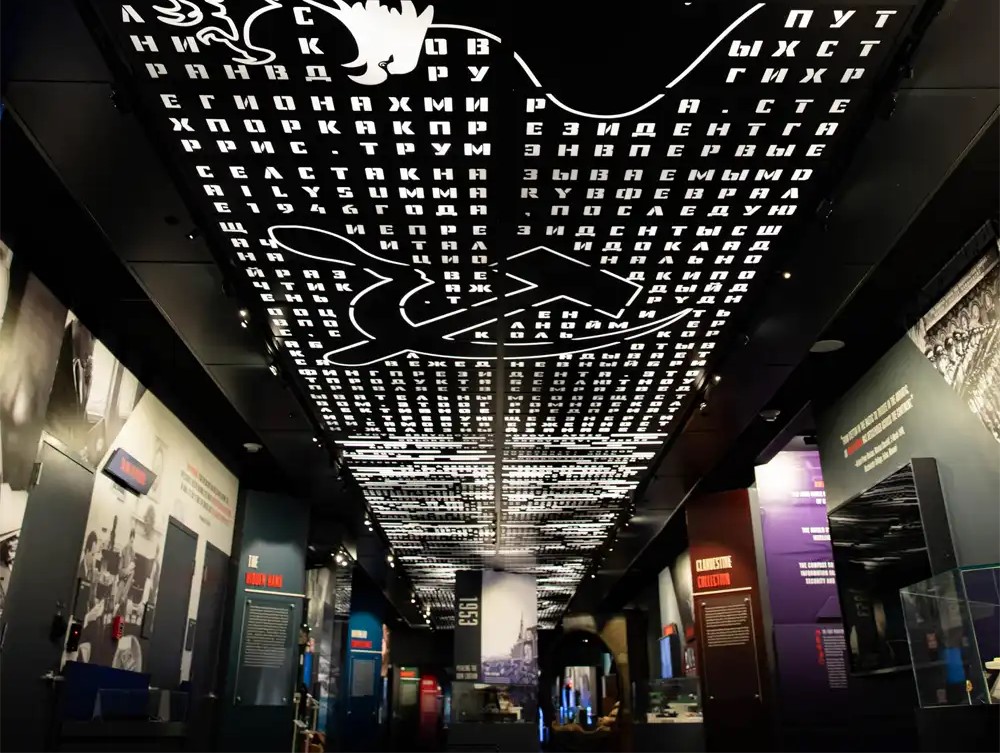
The CIA Museum, located inside the Agency’s Langley, Virginia headquarters, is famously closed to the general public. But even among those who can enter, few realize that one of its most fascinating exhibits isn’t in a display case at all. It’s overhead. The museum’s “coded ceiling” is a sprawling, multi‑panel installation that embeds covert messages into the architecture itself, turning the very roof into an intelligence puzzle.
A Museum That Tells Its Story Twice
The CIA Museum chronicles the agency’s history alongside major global events, but the ceiling adds a second, secret narrative. Each section of the museum features a unique code panel — six in total — designed with graphics, symbols, and text that conceal hidden messages. These aren’t decorative flourishes; they’re deliberate puzzles meant to echo the clandestine communication methods used throughout CIA operations.
The Agency has publicly acknowledged the existence of these messages but, in classic CIA fashion, refuses to confirm or deny any solutions. Visitors (mostly employees, officials, and invited guests) are encouraged to decode them on their own.
A Gallery of Spycraft in Code
The ceiling incorporates a variety of cryptographic styles — each tied to the historical theme of the exhibit below it. Among the confirmed elements:
Morse Code
Above the section on the origins of the CIA, a message appears in Morse code — a nod to early 20th‑century intelligence communication.
Domino Code
Another panel uses dominoes arranged in patterns that correspond to coded values. This reflects the Agency’s long history of using everyday objects as covert signaling tools.
Ciphers and Symbolic Scripts
Other sections include classical cipher systems and abstract symbol arrangements, each chosen to match the era or mission type represented in the exhibit below. The result is a ceiling that functions like a timeline of cryptographic evolution — from analog to digital, from simple substitution to complex algorithmic thinking.
A Rare Glimpse into a Hidden Space
For decades, the CIA Museum was almost entirely inaccessible to the public. Only employees, their families, and official visitors could see it. Recently, however, the Agency has begun offering limited online access through videos and digital exhibits, including a feature episode of The Debrief that highlights the coded ceiling.
This shift coincides with the CIA’s 75th anniversary, during which the museum was renovated and expanded. Journalists given rare access noted that the ceiling, covered in black‑and‑white spy codes, was one of the most unusual and memorable elements of the redesign.
Why Hide Messages in a Ceiling?
The coded ceiling exists as a quiet tribute to the essence of intelligence work. By embedding secret messages directly into the architecture, the CIA honors the tools, techniques, and traditions that have shaped espionage for decades. It’s a reminder that tradecraft isn’t just about gadgets or covert missions — it’s also about the discipline of noticing what others overlook.
At the same time, the ceiling functions as a subtle teaching device. Anyone walking beneath it is invited to think like an analyst: to observe closely, question assumptions, and attempt to decode what’s hidden in plain sight. It turns the museum itself into an exercise in analytical curiosity.
The installation also reflects the Agency’s cultural personality. The CIA has long balanced secrecy with a certain quiet cleverness, and the coded ceiling captures that spirit — playful, enigmatic, and intentionally understated. It’s an inside joke written in cipher, visible only to those who know to look up.
Finally, the ceiling remains a living puzzle. The Agency has never confirmed the solutions to the embedded messages, preserving an air of mystery that encourages ongoing speculation. In a museum dedicated to revealing history, the ceiling reminds visitors that some secrets are meant to linger.
A Puzzle That Watches Over History
The CIA Museum’s coded ceiling is more than just an architectural flourish. It’s a meta‑exhibit, a silent reminder that intelligence work is always layered, always encoded, and always hiding meaning in unexpected places. Even in a museum dedicated to revealing the Agency’s past, the ceiling whispers that some secrets are meant to be discovered, not explained.
