
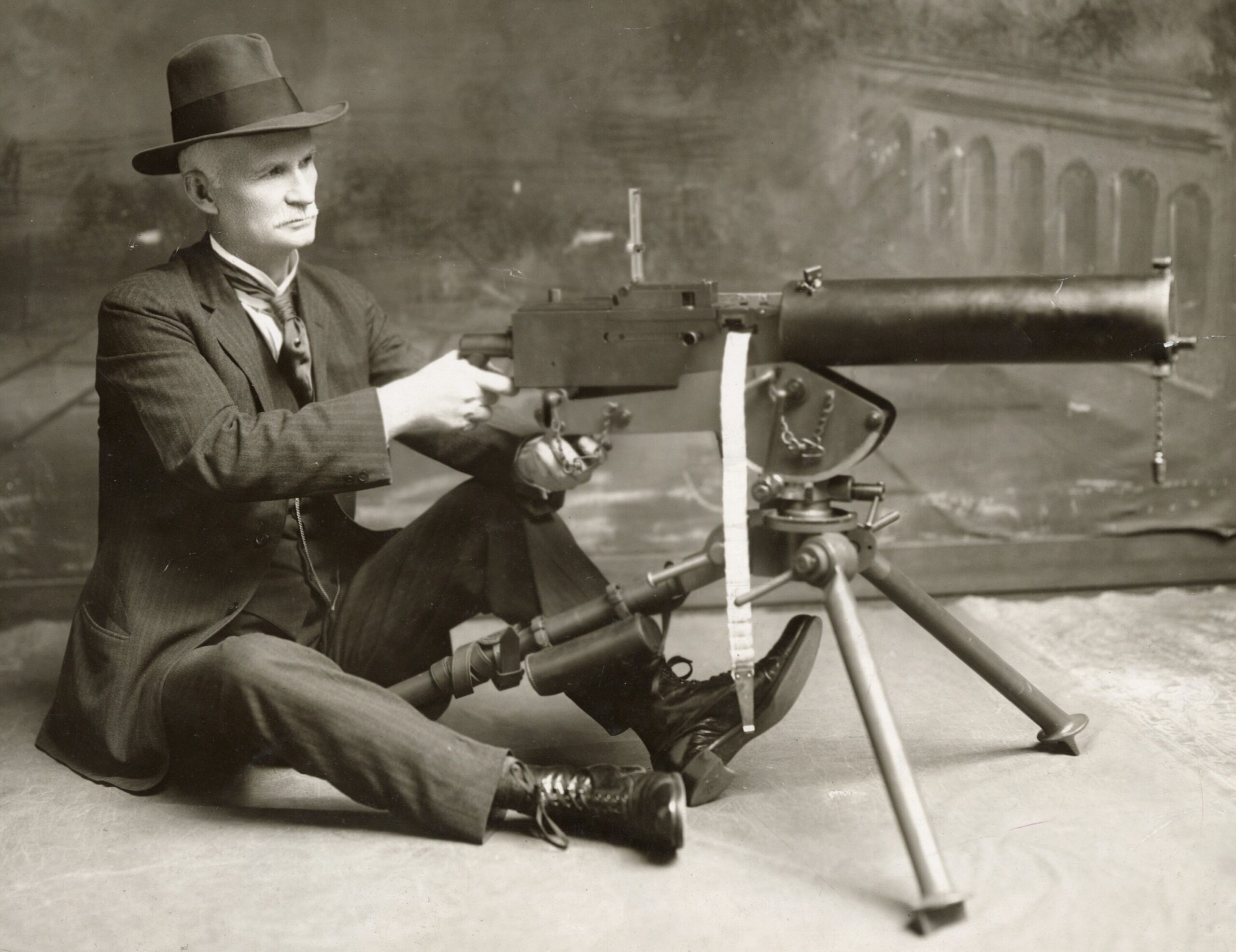
2026 marks the centenary of the passing of a man widely regarded as the father of modern firearms, John Moses Browning. John Browning was born on January 23, 1855, in Ogden, Utah Territory, into a family deeply rooted in craftsmanship and faith. His father, Jonathan Browning, was a skilled gunsmith and a devout member of the Church of Jesus Christ of Latter-day Saints. Jonathan had migrated westward with Mormon pioneers and established a gunsmith shop in Ogden in 1852, where he repaired and built firearms for settlers and frontiersmen.
From a young age, John was immersed in the world of mechanical design. He began working in his father’s shop at the age of seven, learning the intricacies of firearm construction and repair. By the time he was ten, he had built his first firearm, which was a single-shot rifle made from spare parts and a hand-carved wooden stock. Though primitive, the rifle demonstrated his innate understanding of mechanics and foreshadowed a lifetime of innovation.
First Patent and Partnership with Winchester
In 1879, at the age of 24, Browning received his first patent for a self-cocking single-shot rifle. This invention caught the attention of the Winchester Repeating Arms Company, which purchased the patent in 1883. Thus began a long and fruitful partnership that lasted nearly two decades. During this time, Browning designed several iconic lever-action rifles for Winchester, each contributing to the company’s dominance in the firearms market.
Among his most notable designs were the Winchester Model 1886, capable of handling powerful cartridges; the Model 1892, a compact and lightweight rifle ideal for sport and hunting; and the Model 1894, which became one of the most popular hunting rifles in American history. Despite his contributions, Browning received relatively modest compensation, as Winchester retained exclusive rights to manufacture and market his designs. This arrangement eventually led to tensions, especially as Browning began to explore more advanced autoloading mechanisms that Winchester was reluctant to adopt.
Breaking Away and Innovating Autoloading Firearms
By the late 1890s, Browning grew frustrated with Winchester’s conservative approach to innovation. Seeking greater creative freedom and fairer compensation, he ended his relationship with Winchester and began working with other manufacturers, including Colt, Remington, and Fabrique Nationale d’Herstal (FN) in Belgium. This marked a turning point in firearms history, as Browning pioneered the development of semi-automatic and automatic weapons.
His designs introduced mechanisms that allowed guns to reload themselves using recoil or gas pressure, which was a revolutionary concept at the time. Among his most groundbreaking innovations was the Colt–Browning Model 1895, the first successful gas-operated machine gun. He also designed the Browning Auto-5, the world’s first mass-produced semi-automatic shotgun, patented in 1900 and manufactured by FN. The Auto-5 featured a long-recoil operation system that became a standard in shotgun design for decades.
The FN Browning M1900, officially designated as the Modèle 1900 Pistolet Automatique Browning, stands as a landmark in the history of firearms. Manufactured by FN, this semi-automatic pistol was the first production handgun to incorporate a slide, a feature now standard in modern pistols. Its influence extended far beyond its immediate era, laying the groundwork for the semi-automatic pistols that dominate both civilian and military markets today.
Perhaps his most famous creation was the Colt Model 1911, a .45-caliber semi-automatic pistol adopted by the U.S. military in 1911. The Model 1911 became the standard sidearm for American forces and remained in service for over 75 years. Its reliability, stopping power, and ergonomic design made it a favorite among soldiers and civilians alike. The pistol’s short-recoil–operated action became a hallmark of Browning’s genius and is still used in modern firearms.
Military Contributions and World War Impact
Browning’s contributions to military weaponry were profound and far-reaching. His designs armed U.S. and Allied forces during both World Wars, and his weapons were known for their durability, simplicity, and effectiveness in combat. The M1917 water-cooled machine gun was used extensively in World War I trench warfare, providing sustained firepower in grueling conditions. The M1919 air-cooled machine gun became a staple in World War II, mounted on vehicles, aircraft, and used by infantry units.
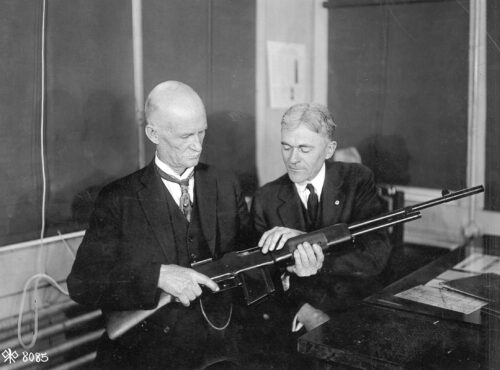
The M1918 Browning Automatic Rifle (BAR) provided infantry with a reliable support weapon, capable of delivering automatic fire while remaining portable. It was used in both World Wars and later conflicts, including Korea and Vietnam. One of Browning’s most enduring military inventions is the M2 .50 caliber machine gun, introduced in 1933. Nicknamed “Ma Deuce,” the M2 is renowned for its power and versatility, serving in roles ranging from anti-aircraft to vehicle-mounted heavy firepower. Remarkably, the M2 remains in active service today, a testament to Browning’s engineering brilliance.
International Influence and Legacy
Browning’s influence extended far beyond American borders. His collaboration with Fabrique Nationale in Belgium led to the production of several legendary firearms, including the Browning Hi-Power, a 9mm pistol that became the standard sidearm for over 50 countries. The Hi-Power was one of the first pistols to feature a double-stack magazine, allowing for higher ammunition capacity without sacrificing ergonomics. It became a favorite among military and police forces worldwide and remains in use today.
His designs touched nearly every category of firearm, from single-shot rifles and lever-action shotguns to semi-automatic pistols and fully automatic machine guns. With over 120 patents to his name, Browning’s engineering principles continue to shape modern firearm design. His ability to blend mechanical simplicity with functional elegance set a benchmark that few have matched. Many of his innovations, such as the tilting barrel locking mechanism and the short-recoil operation, are still foundational in contemporary firearms.
Engineering Genius and Design Philosophy
What set Browning apart was not just his prolific output but his approach to engineering. He viewed firearms as integrated systems, optimizing each component for reliability and ease of use. His designs often featured minimal moving parts to reduce failure, modular construction for easier manufacturing, and intuitive ergonomics for user comfort. Despite having limited formal education, Browning possessed an extraordinary grasp of physics and mechanics. He rigorously tested his prototypes, often in real-world conditions, ensuring that his weapons performed flawlessly under stress.
Browning was known for his relentless pursuit of perfection. He would often build and rebuild prototypes until every detail met his exacting standards. His intuitive understanding of mechanical principles allowed him to innovate far beyond his contemporaries. He was not content with merely improving existing designs, he sought to redefine how firearms functioned. This mindset led to breakthroughs that transformed the industry and set new standards for performance and reliability.
Death and Commemoration
Browning died on November 26, 1926, in Liège, Belgium, while working on a new firearm design at FN’s factory. His passing marked the end of an era, but his legacy lives on. The Browning Arms Company, founded by his descendants, continues to produce sporting rifles, shotguns, and pistols based on his original designs. The Browning Firearms Museum in Ogden, Utah, offers a comprehensive collection of his work, providing visitors with a glimpse into the mind of a man who reshaped the world of weaponry.
Closing Thoughts
John Moses Browning was more than a gunsmith; he was a visionary engineer whose creations changed the course of history. From the rugged lever-action rifles of the American frontier to the automatic weapons that shaped modern warfare, Browning’s legacy is etched in steel and innovation. His designs continue to serve, inspire, and evolve, proving that true genius transcends time. In the annals of engineering and military history, few names shine as brightly as John Moses Browning.
